Sunday, June 14, 2015

Banks annihilating "zombie foreclosures" - from CNBC

They are a blight on neighborhoods and bank balance sheets: homes in the foreclosure process, some in limbo for several years, their former owners gone but the home still not repossessed by the bank. They were dubbed "zombies" because their empty state was seen as a danger to both the neighborhood and the overall health of the housing market. 
Banks had let these homes sit because they were of so little value and because of endless foreclosure processing issues. Most are in disrepair, some occupied by squatters or drug dealers. But now, things are changing. The legal process has been largely streamlined, and as home prices rise nationwide, so too do the values of these zombie homes; banks are now pushing them through the foreclosure process and out to auction far more quickly. 
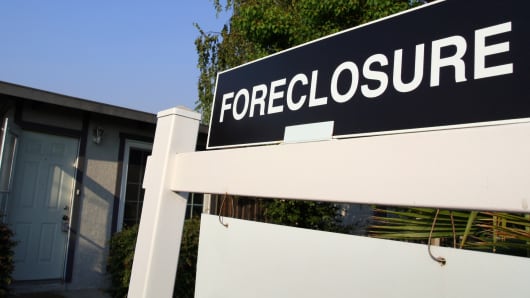
Foreclosure house
Marcelo Piotti | Getty Images
There are now about 127,000 zombie foreclosures, down 10 percent from a year ago, according to RealtyTrac, a foreclosure listing and analytics company. That means that one in five homes that are in the foreclosure process, that is the legal process has started but the bank has not yet repossessed the home, are vacant. 
Despite the overall drop, zombie foreclosures are rising in some of the highest-priced markets, such as Los Angeles, New York, Boston and Houston. That is because banks are moving the process more quickly in order to take advantage of rising home prices; so former owners are finally moving out. When the house is vacant, it becomes a zombie. 
"They've been able to stay in that home and maybe fight foreclosure for three, four, five years, and now finally the bank is coming back with all their ducks in a row, the proper documentation, and the homeowner is seeing the writing on the wall that I'm going to have to leave and move on with my life," said RealtyTrac Vice President Daren Blomquist. 
In just the last two months, banks have really ramped up on repossessing homes. These so-called REOs (bank repossessions) are now at a 17-month high. This, as the value of these former zombies rises amid strong housing demand and tight housing supply. 
"The average price of a zombie foreclosure nationwide was $195,000, so we're not talking about just $20,000 or $30,000 properties here," added Blomquist. 
That is good news to neighbors, like Ariel Seeley, who recently moved into a transitional Washington, D.C., neighborhood with her young family.
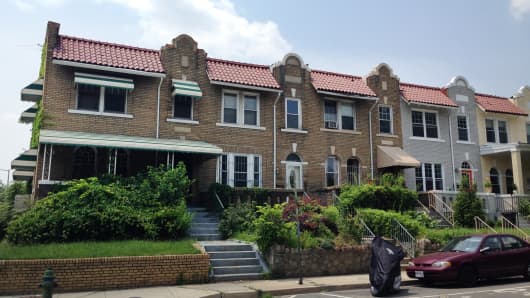
The end unit is a foreclosed, vacant home in Washington, DC's Petworth neighborhood.  RealtyTrac estimates its value at $600,117.
Stephanie Dhue | CNBC
The end unit is a foreclosed, vacant home in Washington, DC's Petworth neighborhood. RealtyTrac estimates its value at $600,117.
"For us as neighbors, we'd love to have people move in and occupy the houses," Seeley said. "It makes it seem a little unsafe or dreary when you're walking by and you see vacant signs, and you don't know what's going on with the houses." 
The phenomenon, however, like all real estate, is very local. While some areas are seeing the zombies annihilated—moved to auction and final sale—quickly, others are not. 
"In Chicago, you've got a real variation within the city among markets. You see stronger neighborhoods where prices have gone up steadily, and those areas are not where the zombie foreclosures are located," said Geoff Smith, executive director of the Institute for Housing Studies at DePaul University. "There are neighborhoods that continue to struggle, and those price levels are still well below where they were at the peak or even in 2000." 
Banks are honing in on foreclosures in stronger local markets, but there is a cost to completing a foreclosure and a cost to selling the property, and in some areas there is not necessarily a market that would bear these costs. In those cases, the vacant homes sit longer and continue to be a blight on the neighborhood. 
—CNBC producer Stephanie Dhue contributed to this report.

Buyers Scramble to Buy Homes as Interest Rates Increase - from CNBC

The interest rate sharp jump to the highest level this year caused a sudden surge in mortgage applications. While that may seem counter-intuitive, there's a reason: fear that rates will move even higher.  
Total mortgage application volume jumped 8.4 percent on a seasonally adjusted basis last week from the previous week, according to the Mortgage Bankers Association. The previous week included an adjustment for the Memorial Day holiday.
"Mortgage application volume rebounded strongly … indicating that the holiday had a larger impact on business activity than originally assumed," said Mike Fratantoni, the association's chief economist.
Refinance volume increased 7 percent on the week, and applications to purchase a home jumped 10 percent, both seasonally adjusted. Purchase volume is now 15 percent higher than the same week one year ago, but refinance volume is off nearly 5 percent. The weekly move higher in refinances was likely due to the holiday skewing the trend. Refinances are still lower than they were two weeks ago. This all comes as rates continue to climb.
The average contract interest rate for 30-year fixed-rate mortgages with conforming loan balances ($417,000 or less) increased to 4.17 percent, its highest level since November, from 4.02 percent, with points increasing to 0.38 from 0.33 (including the origination fee) for 80 percent loan-to-value ratio loans, according to the association. 
While higher rates make home buying more expensive, sharp moves higher often have the immediate effect of getting potential buyers off the fence, before chilling the overall market in the longer term. That is especially true now, in light of rising bond yields and the Federal Reserve's expected interest-rate hike.
"These increases really help the home-buying market. It really gets buyers to really understand that 'wait a minute, rates are at an all-time low, let's react now, let's react before they go higher,'" said Matt Weaver of Florida-based PMAC Lending.
Weaver said last week that he had a rush of clients calling in to lock-in rates. That was probably smart, as rates continued their move higher in yet another bond market sell-off. Both the spike in foreign bond yields as well as strong U.S. economic data point to an upward trajectory for interest rates, at least in the short term.
While the surge in purchase applications would seem to be welcome news, especially as the usually busy spring market draws to a close, some analysts warn the picture is not as rosy as it looks. 
"We think the excitement is misplaced," analysts at Goldman Sachs said in a note to investors Tuesday. "This index [mortgage bankers' purchase application index] has been largely range-bound since 2010. Even after the recent increases, it is still at levels comparable to 1996 when the size of the population and housing stock were 15 percent smaller." 
Mortgages
30 yr fixed4.09%4.18%
30 yr fixed jumbo4.33%4.45%
15 yr fixed3.21%3.37%
15 yr fixed jumbo3.80%4.01%
5/1 ARM3.38%5.48%
5/1 jumbo ARM3.44%5.97%
Find personalized rates:

Monday, June 21, 2010

4430 Wimberly Way, Cumming, GA | Powered by Postlets

4430 Wimberly Way, Cumming, GA Powered by Postlets
Click above to view my latest listing!

June 16th Update!

Today, the Senate passed an extension to the tax credit. However, the credit provision is part of a larger jobs and tax package that both chambers must still vote on before it becomes law. This extension, if passed, would allow only those individuals who already have signed contracts to complete the transaction after June 30th. More information will be passed along as Congress works on this extension.


~~~~~~~~~~~~~~~~~~~~~~~~~~~~~~~~~~~~~~~~~~~~~~~~~~~~~~~~~~~~~~~~~~~~~~~~~~~~~~~~~~~~~~~~~~~~~~~~~~~~~~~~~~~~~~~~~~~~~~~~~~~~~~~~~~~~~~~~~~~~~~~~~~~

WASHINGTON — The Senate on Wednesday approved a plan to give home buyers an extra three months to finish qualifying for federal tax incentives that boosted home sales this spring. The move by Senate Majority Leader Harry Reid would give buyers until Sept. 30 to complete their purchases and qualify for tax credits of up to $8,000. Under the current terms, buyers had until April 30 to get a signed sales contract and until June 30 to complete the sale. The proposal, approved by a 60-37 vote, would only allow people who already have signed contracts to finish at the later date. About 180,000 homebuyers who already signed purchase agreements would otherwise miss the deadline.

Reid, D-Nev., added the proposal to a bill extending jobless benefits through the end of November. Nevada has the nation's highest foreclosure rate, and Reid is facing a tough re-election campaign. The Realtors group has been pushing hard in Congress for the extension. Mortgage lenders, the trade group says, have been swamped with borrowers trying to get approved by the end of the month. Many potential borrowers are unlikely to make the deadline. "If Congress fails to act promptly, then prospective homebuyers might not get the benefit of the homebuyer tax credit, even though they have completed contracts," the Realtors said in a letter to lawmakers.

First-time buyers were eligible for a tax credit of up to $8,000. Current owners who bought and moved into another home could qualify for a credit of up to $6,500. The $140 million cost of the measure would be financed by denying businesses the ability to deduct from their taxes punitive damages paid when losing lawsuits or judgments.

The information above was provided by James A Williamson of Fairfield Mortgage.

May 26th Update!

Mortgage Rates Plummet


Just when everyone seems to be predicting that mortgage rates will rise, out of the blue they have dropped to the low point of the year! This remarkable development has occurred for the following three reasons:

1. Global economic concerns. The trouble in Europe continues to brew and threatens to spread as European countries are forced to reduce government spending. In addition, Chinese officials are now focused on tightening monetary policy to reduce inflation. Also, tensions between North Korea and South Korea continue to build. Investors have reacted to these crises by shifting money to relatively safer assets such as bonds and U.S. mortgage-backed securities (MBS) and this has had the effect of pushing mortgage rates lower.

2. Domestic economic uncertainty. In the U.S., it's not clear to what degree a newly proposed financial regulation bill will cause banks to reduce lending and lead to slower economic growth. In response to periods of uncertainty such as this, investors seek to reduce risk by moving to safer assets which, again, has led to lower rates.

3. Tame inflation. April Core CPI inflation fell to the lowest level in 44 years!! Low inflation always equates to low rates.


Mostly Positive Economic Data

On the housing front, recent news has been mostly positive. March Pending Home Sales increased 5.3% from February and were 21% higher than one year ago at this time. April Housing Starts increased above the consensus forecast to the highest level since October 2008. In addition, the May NAHB Homebuilder confidence index rose to the highest level since August 2007. Although the number of builder permits declined moderately, builders surveyed remained optimistic about sales over the next six months even as the home buyer tax credit expired.

More good news to report as retail sales rose for 7th straight month and oil prices fell to $65 per barrel reaching the lowest level since July 2009. The correlation between oil prices and mortgage rates is staggering!

On the jobs front, the weekly jobless claims unexpectedly jumped well above the consensus forecast and this figure will be closely watched over the next few weeks.

Flood Insurance Program Set to Expire

The National Flood Insurance Program is set to expire on May 31st. By law, a lender has to check to see if a property is in a flood zone before a mortgage can close. If the flood cert comes back negative (as most in Atlanta area do), there isn't an issue. However, if it comes back positive, the appropriate flood insurance coverage must be obtained prior to closing. If Congress does not address this issue and extend the program this week (they are not in session next week), the program will expire for the third time this year! This means that any loan closings scheduled that do not have the required flood insurance arranged by Friday will have to be delayed. Just what we need in this market! Congress has allowed this issue to linger for months and one existing proposal only would extend the program through Dec 31. Our elected officials need to figure this one out and quick or there are going to be some serious repercussions to anyone wanting to buy a house who needs flood insurance.


Rate Update

Mortgage rates have reached the lowest point since early December of 2009!

Looking Ahead

The last half of this week will be busy with New Home Sales and Durable Orders figures being released today. Also, a revised figure for first quarter Gross Domestic Product (GDP) will be released tomorrow and the Chicago PMI Manufacturing Index and Personal Income on Friday. Consumer Sentiment and Consumer Confidence round out the busy week.

All information above was provied by James A Williamson of Fairfield Mortgage

Sunday, May 16, 2010

Real Estate Update, May 16th 2010

Greek Troubles Overshadow Strong Data


Last week, the global financial markets remained focused on the economic troubles of Greece. Greek workers responded to proposed austerity measures with strikes and riots, and investors grew increasingly concerned that other smaller European countries will face similar problems cutting their budget deficits. As a result, US mortgage markets were helped in two primary ways:

1. Investors sought a flight to quality and shifted funds to safer investments, including US Treasuries and mortgage-backed securities (MBS).

2. Continued economic turmoil in Europe will reduce US exports to the region, which will slow US economic growth and reduce inflationary pressures.

Increased demand for MBS and lower future inflation are both positive for mortgage markets and contributed to keeping mortgage rates low over the last week.

Strong April Employment Report

Last week's April Employment report exceeded expectations in nearly every area. Against a consensus forecast of 190K, the economy added 290K jobs in April, the most since March 2006! In addition, the data from prior months was revised higher by an additional 121K. The manufacturing sector also added the most jobs since 1998! The Unemployment Rate rose to 9.9% from 9.7%, but that was due to unexpectedly large growth in the labor force as more people began to seek jobs.


The Fed Stays the Course

The recent Federal Open Market Committee ended without any major changes. The Fed kept the Fed Funds Rate the same and made no change to their Policy Statement, stating that rates will remain low for an "extended period" of time. Although the Fed does not directly control residential mortgage rates, there are presently three major threats to low rates lurking out there that do relate to the Fed:

1. The Fed made no mention in their latest Policy Statement about selling any of their Mortgage Backed Security (MBS) holdings. However, minutes from the meeting will be released at a future date and if the Fed discussed this topic at the meeting, it could cause rates to rise.

2. There is growing concern that if the Fed doesn't begin selling some of their MBS holdings by 2011, additional asset bubbles may arise. It's likely that the Fed will look to sell a meaningful chunk before year-end and, when this does happen, there stands to be some upward pressure on rates at that time.

3. Despite a stronger Stock market, higher consumer confidence, and an improved housing market, St. Louis Fed President Thomas Hoenig remains the lone dissenter to the verbiage in the Policy Statement regarding keeping rates low for an "extended period." He feels that there is a strong risk of inflation ahead and that the Fed needs to prepare the markets for the eventual hikes that will be coming to the Fed Funds Rate. When other Fed members agree with Hoenig (and the day will come), this verbiage will change and this will be a signal that the Fed now considers inflation to be a real threat. Since inflation is the archenemy of mortgage rates, the change in verbiage will cause rates to move higher.